Who it's for Restaurants and cafés
From the order to the plate, nothing gets lost.
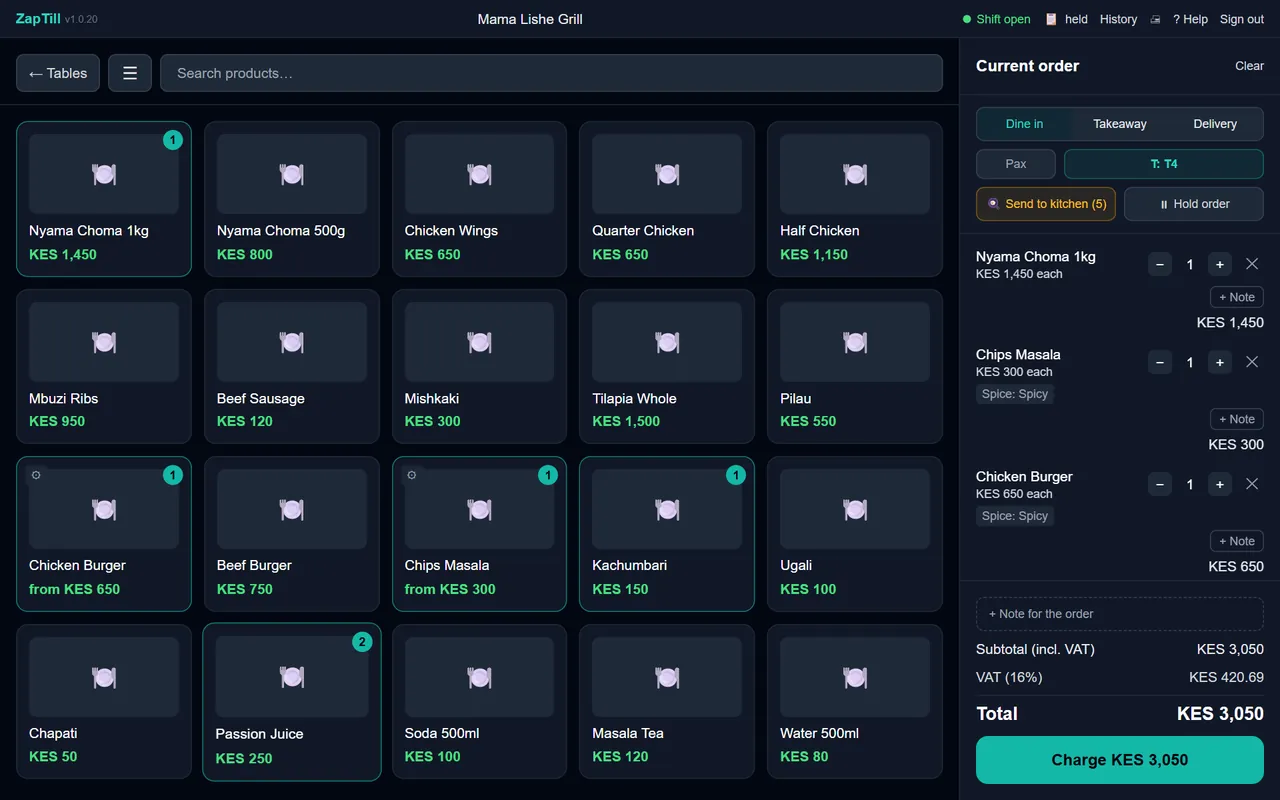
ZapTill sends every order to the right station as it's taken, keeps tables open while they eat, takes M-Pesa at the table, and closes the day by cashier.
What goes wrong, and what ZapTill does about it
The waiter shouts the order and the kitchen hears it wrong.
The order prints in the kitchen, or appears on the kitchen screen, the moment it is sent. The variant is on the dish's own line: "2 CHIPS MASALA - SPICY", and the extras and the cashier's notes print under it: "+ Extra Cheese", "** No onions". Nobody has to remember anything.
The grill gets the drinks, and the bar gets the chips.
Each part of your menu goes to its own station: the grill, the kitchen, the bar or dispatch. Drinks skip the kitchen and go straight to whoever packs the tray.
A takeaway goes out without its sauce.
The dispatch ticket lists every part of every combo, and counts the bags, so the packer checks the bag against the paper.
Table 7 has waited twenty minutes, and nobody noticed.
On the kitchen display every order is a card with a timer, moving from Pending to In progress to Ready. The late one is easy to see.
The day ends and the cash doesn't match.
Each cashier counts their own drawer. ZapTill shows what should be there, what was counted and the difference, by name, before anyone goes home.
One order, three places, the same words
Table 4 orders. The kitchen sees the food, dispatch sees everything for the tray, and the customer's receipt shows the same dishes with the M-Pesa number. These are the real tickets ZapTill prints, for a demo order.
Extras and notes reach the cook
"Extra cheese, no onions" doesn't stay at the counter. Extras and the cashier's notes print on the kitchen ticket, under the dish they belong to, and on the dispatch ticket too, so the packer checks them. Some things only the chef can do.
A kitchen screen, if you'd rather not use paper
Each order arrives as a card with a timer. The cook taps it from Pending to In progress to Ready, and the waiter knows when to collect. Variants and extras sit under the dish.
Use a printer, a screen, or both: the grill on paper and the pass on a screen.
0:48
- ×1 Nyama Choma 1kg
- ×2 Chips MasalaSpice: Spicy
- ×1 Chicken BurgerSpice: Spicy
- ×1 Kachumbari
4:12
- ×2 Chicken Wings
- ×1 Chips MasalaSpice: Normal
7:30
- ×1 Tilapia Whole
- ×2 Ugali
- ×1 Kachumbari
11:05
- ×3 Mishkaki
- ×1 Pilau
Built around how a restaurant sells
Combos and variants
"Chicken Burger - Spicy" is one line on the receipt and the ticket. A combo lists its parts, so the kitchen cooks every piece and dispatch packs every piece.
Tables and dine-in
Open a table, send the first round to the kitchen, add to it later and take payment when they ask for the bill. Takeaway and delivery from the same screen.
Your menus, as big tabs
Food, Drinks, Tea: your menus sit as big tabs across the top of the till, so the cashier changes menu in one tap. Big buttons and, with ZapTill Online, pictures of your dishes.
Credit for your regulars
The office that pays at the end of the month gets an account with a credit limit. The cashier puts the bill on their account at the till, every sale on account is confirmed by a manager, and you see who owes what.
Variants, pictures and offers on the till come with ZapTill Online. See the packages
Then: which dishes earn, and when to push them
With Analytics, your menu is sorted into the dishes that earn and the ones that only keep the kitchen busy, and you see what sells at lunch, what sells after six, and what to prepare each day of the week. The cards tell you what to do about it, in plain words: what to order, what to have in for Saturday, which dish to feature. They never tell you to raise your prices.
Feature Tilapia whole at lunch
It leaves KES 900 each, KES 649 more than your average, but only 140 sold in 30 days, 75% of them at lunch.
Estimate: ≈ KES 25,200 a month more profit
If featuring it lifts its sales by 20% (about 140 to 168 a month) at today’s margin.
Questions owners ask us
Can different dishes go to different printers?
Yes. Each part of your menu can go to its own station: the grill, the kitchen, the bar or dispatch. The cook only gets what they cook, and the dispatch ticket lists everything that goes into the bag or onto the tray.
Do I need a kitchen screen, or will printers do?
Either works. Many kitchens start with a printer. A kitchen display shows each order as a card with a timer, and the cook taps it through Pending, In progress and Ready.
Can waiters keep a table open and add to it?
Yes. Open a table, send the first round to the kitchen, add more later, and take payment when the table asks for the bill. An order can also be held and picked up again.
How do combos and variants print?
On one line where they can: "Chips Masala - Spicy" on the receipt and the kitchen ticket. A combo lists its parts under it, so the kitchen sees every piece and dispatch packs every piece.
Do I need internet?
Not to sell. Your tills keep selling and printing receipts with no internet, and a branch server keeps every till in the shop in step. When the internet comes back, everything catches up by itself.
You need internet to see your numbers from somewhere else, and for the daily summary to reach you.
See a lunch rush on ZapTill, with your own menu.
We set it up on site, load your menu or stock, and train your team. Start with a message.
Also: bars and lounges, quick service and takeaways, shops and retail.